Be Well.

Robot workers are coming for your job!
By Gary Vey for viewzoneWith the current recession and unemployment, especially in the automotive industry, we should expect that our government would be finding ways to get us all back to work again. Wrong. The latest announcement on February 7th, 2010, seems almost too strange to believe.
According to ScienceDaily, NASA and General Motors are working together to accelerate development of the next generation of robots and related technologies for use in the automotive, aerospace and manufacturing industries.
That's right -- robots!
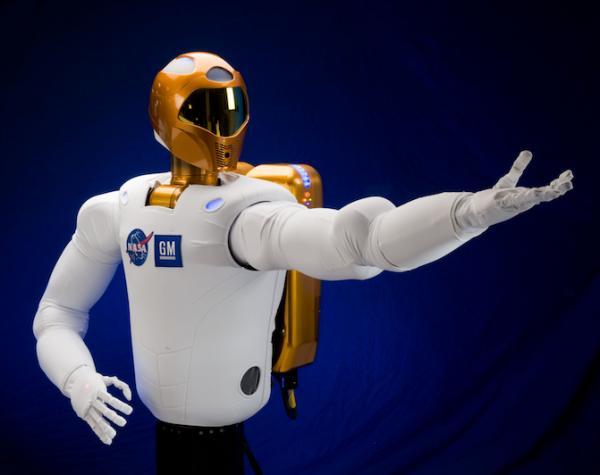 The two organizations, with the help of engineers from Oceaneering Space Systems of Houston, developed and built the next iteration of Robonaut. Robonaut 2, or R2, is a faster, more dexterous and more technologically advanced robot. This new generation robot can use its hands to do work beyond the scope of prior humanoid machines. R2 can work safely alongside people, if needed, a necessity both on Earth and in space.
We're not talking about mechanical arms that spotweld frames either. These new robots resemble humans and have human-like arms and hands that can be programmed to function just like -- or even better than -- "real" workers. With today's computers and fast processors, these robots can be programmed to make decisions, change tools and assemble intricate parts at a higher speed and with less errors than a human being.
Engineers and scientists from NASA and GM worked together through a Space Act Agreement at the agency's Johnson Space Center in Houston to build this first humanoid robot capable of working in the automotive and aerospace factories of the very near future, but minor adaptations could utiliza these robots in virtually any manufacturing environment.
Using leading edge control, sensor and vision technologies, future robots could help GM build safer cars and factories. In fact, they may even be able to design and build themselves someday. And what is even more attractive to the business community -- they don't belong to unions, need medical insurance, vacations or a salary!
The two organizations, with the help of engineers from Oceaneering Space Systems of Houston, developed and built the next iteration of Robonaut. Robonaut 2, or R2, is a faster, more dexterous and more technologically advanced robot. This new generation robot can use its hands to do work beyond the scope of prior humanoid machines. R2 can work safely alongside people, if needed, a necessity both on Earth and in space. "This cutting-edge robotics technology holds great promise, not only for NASA, but also for the nation. I'm very excited about the new opportunities for human and robotic exploration these versatile robots provide across a wide range of applications." -- Doug Cooke, associate administrator for the Exploration Systems Mission Directorate at NASA Headquarters in Washington.
NASA and General Motors have come together to develop the next generation dexterous humanoid robot workers. The robots -- called Robonaut2 -- were designed to use the same tools as humans.  The idea of using dexterous, human-like robots capable of using their hands to do intricate work is not new to the aerospace industry. The original Robonaut, a humanoid robot designed for space travel, was built by the software, robotics and simulation division at Johnson in a collaborative effort with the Defense Advanced Research Project Agency 10 years ago. During the past decade, NASA gained significant expertise in building robotic technologies for space applications. These capabilities will help NASA launch a bold new era of space exploration.
"For GM, this is about safer cars and safer plants. When it comes to future vehicles, the advancements in controls, sensors and vision technology can be used to develop advanced vehicle safety systems. The partnership's vision is to explore advanced robots working together in harmony with people, building better, higher quality vehicles in a safer, more competitive manufacturing environment." -- Alan Taub, GM's vice president for global research and development.
The idea of using dexterous, human-like robots capable of using their hands to do intricate work is not new to the aerospace industry. The original Robonaut, a humanoid robot designed for space travel, was built by the software, robotics and simulation division at Johnson in a collaborative effort with the Defense Advanced Research Project Agency 10 years ago. During the past decade, NASA gained significant expertise in building robotic technologies for space applications. These capabilities will help NASA launch a bold new era of space exploration.NASA and GM have a long, rich history of partnering on key technologies, starting in the 1960s with the development of the navigation systems for the Apollo missions. GM also played a vital role in the development of the Lunar Rover Vehicle, the first vehicle to be used on the moon.
This effort will allow GM and other industries to replace hundreds or thousands of skilled assembly and manufacturing workers with robots that have the same manual dexterity as humans. The advantages to the corporate world and their profits is enormous. The downside is obvious. Unemployment will not recover for hese jobs and the leverage that unions once had in securing benefits such as health care and retirement will be lost. It will be more efficient and less expensive to use a robot than to employ a real human.
This is just fantasy?
The recent Supreme Court ruling that gives corporations the green light to spend ANY amount of funds to influence laws and political elections almost guarantees that this type of automation will be implemented. The shift towards "profit rights" and away from "human rights" has already been started, and cannot legally be reversed. One can only imagine what type of future our children, and their children, will inherit.
What's your opinion on this?
No comments:
Post a Comment