Be Well.
David
Drought of 2012 conjures up Dust Bowl memories, raises questions for tomorrow
September 15, 2012 -- Updated 1653 GMT (0053 HKT)
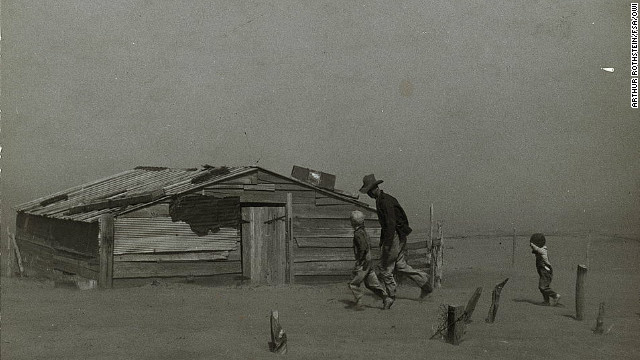
A farmer and sons walk in the face of a dust storm in Cimarron County, Oklahoma, in April 1936.
(CNN) --
Some 3.5 million people fled their homes in Oklahoma, Texas, and
elsewhere, the bone-dry landscape, blistering heat and choking dust
storms unfit for growing and raising the crops and cattle they relied on
to survive.
Thousands
more, many of them children and seniors, could not escape, killed by an
infection dubbed "dust pneumonia" and other illnesses tied not just to
the extreme weather and poor living conditions but to massive,
fast-moving dust clouds.
Those clouds and barren terrain across much of middle America gave this period of despair its name: the Dust Bowl.
There were suicides,
there were bankruptcies, there were people scrapping for whatever they
could find to live. And these were not overnight horror stories: They
were repeated day after day and year after year, at a time when much of
the United States and world was already debilitated by the Great
Depression.
"If
you can imagine what's happening now and multiply it by a factor of
four or five, that's what it was like," said Bill Ganzel, a
Nebraska-based media producer who interviewed survivors of the 1930s'
environmental and economic disaster and penned a book, "Dust Bowl
Descent." "And it lasted for the entire decade."
Nothing
in U.S. history can compare to that calamity of eight decades ago,
including the historic drought now gripping much of the country.
That
doesn't mean, though, there isn't considerable
suffering and devastation now in most of the United States. Or that
dire conditions could well persist for several years, as they did during
the 1930s -- compounding negative impacts of drought, thus ruining even
more livelihoods and lives despite technological and agricultural
advancements of recent years.
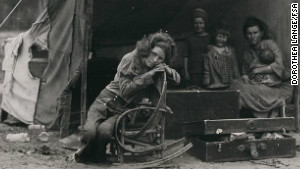
Florence Thompson, right, and her children were featured in Dorothea Lange's "Migrant Mother" photo.
"Mother
Nature holds all the cards,"
said Mark Svoboda, a climatologist with the National Drought Mitigation
Center. "You roll the dice ... every year. Nothing will make you
quote-unquote drought-proof."
This
year, Hurricane Isaac helped alleviate the current drought in some
locales, but not in most, and certainly nowhere near enough to put a big
dent in a phenomenon that's affected millions.
Is it happening again?
Over
63% of the contiguous United States in early September was suffering
moderate to exceptional drought, nearly twice the land affected a year
ago, according to the U.S. Drought Monitor. Using July data, the
National Climatic Data Center reported that America is in the midst of
its most expansive drought since December 1956.
The
combination of dry conditions and extreme heat -- including hundreds of
record-breaking temperatures this summer -- has been unbearable for
many. The drought's impact has been seen in ways big and small, from
leaves falling early and lawns turning brown to farmers giving up and
lakes drying up, exposing hundreds of dead fish.
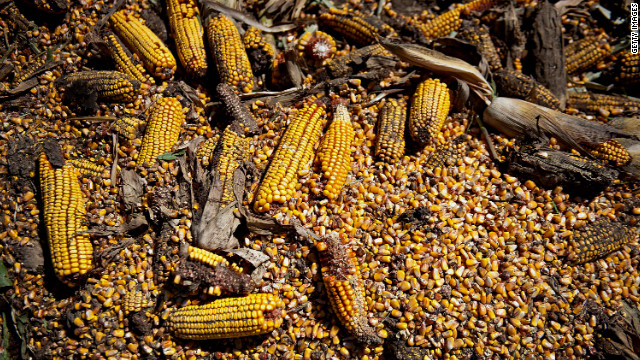
"It
does look like a moonscape," Svoboda said of parts of western Oklahoma,
where dirt drifts into mounds and soil climbs over fence posts. "There
are some parts of the country where (dire farming conditions) have
nothing to do with them failing to till over the soil," as was commonly
blamed for "dust storms" of the 1930s.
Driving
through southern Wisconsin, CNN iReporter Jim Jostad saw heap after
heap of chopped-down corn sacrificed by farmers who had conceded this
year's crop, hoping if anything to salvage some of the loss by selling
off as cattle feed what did sprout up.
Dozens
of farmers markets in Oklahoma were without vendors months
earlier than had been expected because their bounty was so meager, said
Nathan Kirby of the state's Department of Agriculture, a year after
closing even earlier due to similarly hot, arid conditions.
While
consumers may be worried about rising food prices tied to the drought,
many farmers have seen their incomes all but evaporate because crops
won't grow -- finding even irrigated farmlands cannot pump in enough
moisture, given the rate it evaporates back into the atmosphere in high
heat.
It
hasn't been easier for those who raising cattle and other
animals, at a time of scorched pastures and scanty, costly hay and
other feed. Ranchers have been forced to prematurely sell off their
cattle, saying they had no other choice because it cost more to feed
them than to keep them.
Oklahoma
ranchers "liquidated" -- meaning slaughtered or sold off, without
replacing them with newborns or new purchases -- 14% of their livestock
last year, said Derrell Peel, an Oklahoma State University faculty
member who works with ranchers and affiliated companies in that state.
The only reason rates haven't been similarly high after this summer is
because ranchers don't have as many animals to sell, he said.
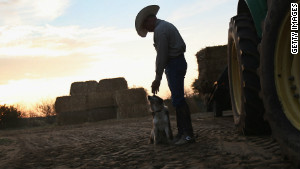
The nation's severe drought has been especially hard on cattlemen like Colorado rancher Gary Wollert.
Families
trying to make a living raising cattle have been especially hard
pressed. Take Mark Argall of Mountain Grove, Missouri, who sold 33 of
his cherished cows (leaving only a few behind) for less than half what
they might have earned before the drought.
"They're
not just numbers on a computer," Argall said. "They're members of the family."
Can it happen again?
So what can be done to prevent another Dust Bowl disaster?
Rains
from Hurricane Isaac might have made
headlines, but they alone won't make a dent in the drought. Ironically,
the Dust Bowl era had wet spells, too -- including flash floods in the
Great Plains -- though they did not alter the devastating equation much,
according to U.S. Department of Agriculture meteorologist Brad Rippey.
What
farmers and ranchers do have working in their favor, compared to the
1930s, are new tools, techniques and other developments that help them
better manage droughts, storms and other harsh weather realities.
Svoboda,
with the National Drought Mitigation Center, rattles off several such
changes -- from more effective soil preservation measures to hybrid
seeds to the inception of center pivot irrigation. He adds, too, that
things like cell phones and computers make it easier for farmers,
ranchers and others to understand what's coming, then adjust.
And
the most significant difference between the 1930s and today -- and the
main reason for hope that it won't be as bad -- is time. The Dust Bowl
era is generally defined as an eight-year stretch; while parts of
Oklahoma and Texas are in the second year of drought, the rest of the
United States is in its first.
In other words, there's still a long way to go.
If the precipitation picks up, "row farmers" cultivating crops like corn, soy beans and sorghum
using modern farming practices should be able to recover next year.
"If
they have a normal rain pattern, it's basically a zero recovery
period," said Rippey. "You are going from a (devastated) 2012 crop to
normal."
But
those raising livestock may feel the effects of this drought for
longer, even if there's more rain. Some strained pastureland and hay
fields may revive with above average, more sustained rainfalls than
ordinary. But other lands may be a lost cause, with replanting the only
way to save them. Peel called the next one to two months "critical,"
as some rain soon may help save these lands so ranchers do not have to
start from scratch.
Still,
even if their pastures improve or hay prices drop, those who sold off
many of their livestock in recent years likely cannot afford to buy the
same number back, and return to normal, anytime soon.
"Grazing
and ranching are totally at the mercy of rain-fed crops and pastures,"
said Svoboda, pointing especially to the susceptibility of grass and hay
to a lack of moisture and excess of heat. "They just don't control
those factors at all."
If
drought conditions do persist, they can have a steamroller effect. "The
suns' rays are more efficient (when) you have parched soils," said
Rippey, the USDA meteorologist, adding that it becomes harder for new
moisture to make an immediate impact.
"These droughts, when they tend to go multiple years, it really starts to feed on itself," adds Svoboda.
We haven't got there quite yet, but we could be if more precipitation doesn't fall over the Great Plains and beyond.
As
they try to predict the drought's future, meteorologists say they will
look first to whether this fall and winter are
wetter and cooler than last year, hoping that it will saturate soils
and rivers and spur a wetter trend that continues into next spring and
summer.
As
is, some states out west had two straight La Nina winters that "tend to
really suck you dry," Svoboda explained. Typically lasting a year or
two, La Nina is characterized by cooler than normal sea-surface
temperatures in the central and eastern Pacific Ocean that has a domino
effect on global weather -- leading to more rainfall than normal in some
locales and drought in others.
"If
we had a third
consecutive La Nina, there are some statistics that would be scary," he
added. "But the odds of La Nina (continuing) are very small right now."
Still,
no one predicted practically a full decade of minimal rain, maximum
heat during the Dust Bowl era either. The fact is, for all the forecasts
and farming innovations, keeping one's fingers crossed for change in
the weather may be as useful as anything else.
"Right now, it's just a question of Mother Nature giving us a break," said Derrell Peel, from Oklahoma State.
No comments:
Post a Comment