Dear Friends,
http://www.kurzweilai.net/ibm-reveals-five-innovations-that-will-change-our-lives-within-five-years
Be Well.
David
http://www.kurzweilai.net/ibm-reveals-five-innovations-that-will-change-our-lives-within-five-years
Be Well.
David
IBM reveals five innovations that will change our lives within five years
The era of cognitive systems: when computers will, in their own way, see, smell, touch, taste and hear
December 18, 2012
IBM announced today the seventh annual “IBM 5 in 5”
— a list of innovations that have the potential to change the way
people work, live and interact during the next five years, based on
market and societal trends as well as emerging technologies from IBM’s R&D labs. This one is focused on cognitive systems.
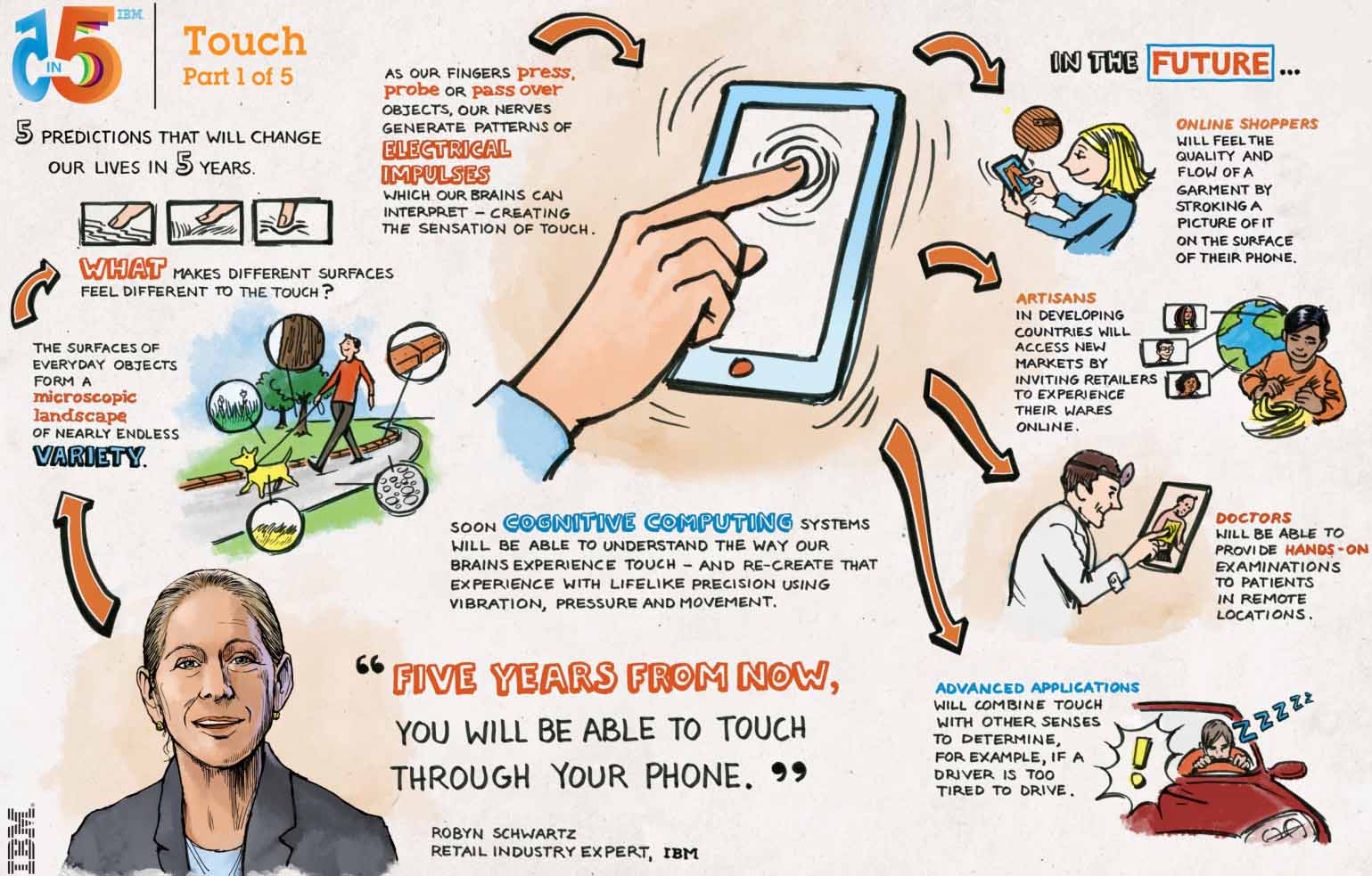
In the next five years, industries such as retail will be transformed
by the ability to “touch” a product through your mobile device, using
haptic, infrared and pressure-sensitive technologies to simulate touch —
such as the texture and weave of a fabric as a shopper brushes their
finger over the image of the item on a device screen.
Each object will have a unique set of vibration patterns that
represents the touch experience: short fast patterns, or longer and
stronger sets of vibrations. The vibration pattern will differentiate
silk from linen or cotton, helping simulate the physical sensation of
actually touching the material.
Current uses of haptic and graphic technology in the gaming industry, for example, will take the end user into a simulated environment.
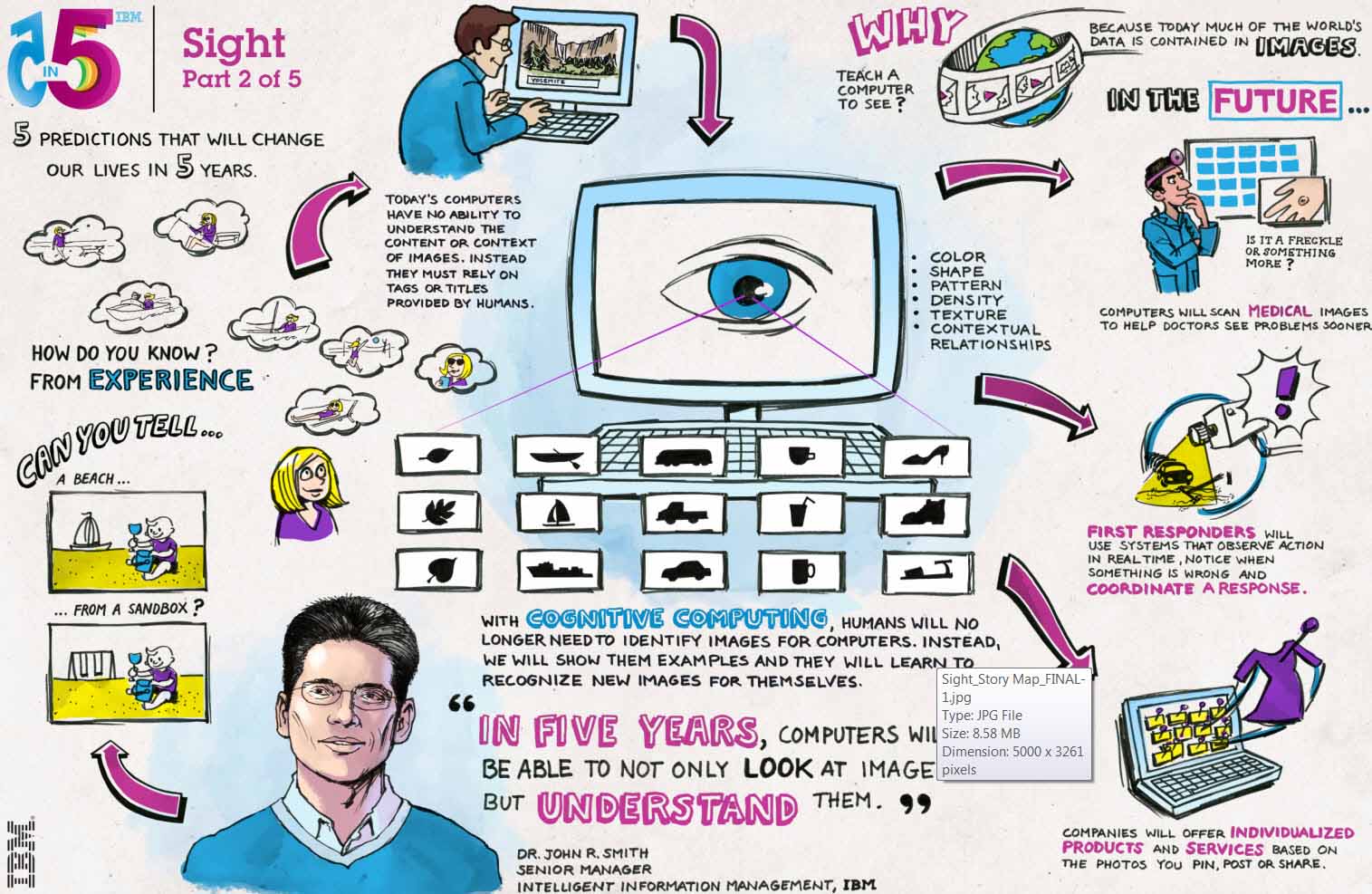
We take 500 billion photos a year[1]. 72 hours of video is uploaded to YouTube every minute[2]. The global medical diagnostic imaging market is expected to grow to $26.6 billion by 2016[3].
In the next five years, “brain-like” capabilities will let computers
analyze features in visual media such as color, texture patterns, or
edge information and extract insights. This will have a profound impact
for industries such as healthcare, retail and agriculture.
These capabilities will be put to work in healthcare by making sense
out of massive volumes of medical information, such as MRIs, CT scans,
X-Rays and ultrasound images, to capture information tailored to
particular anatomy or pathologies. By being trained to discriminate what
to look for in images — such as differentiating healthy from diseased
tissue — and correlating that with patient records and scientific
literature, systems that can “see” will help doctors detect medical
problems with far greater speed and accuracy.
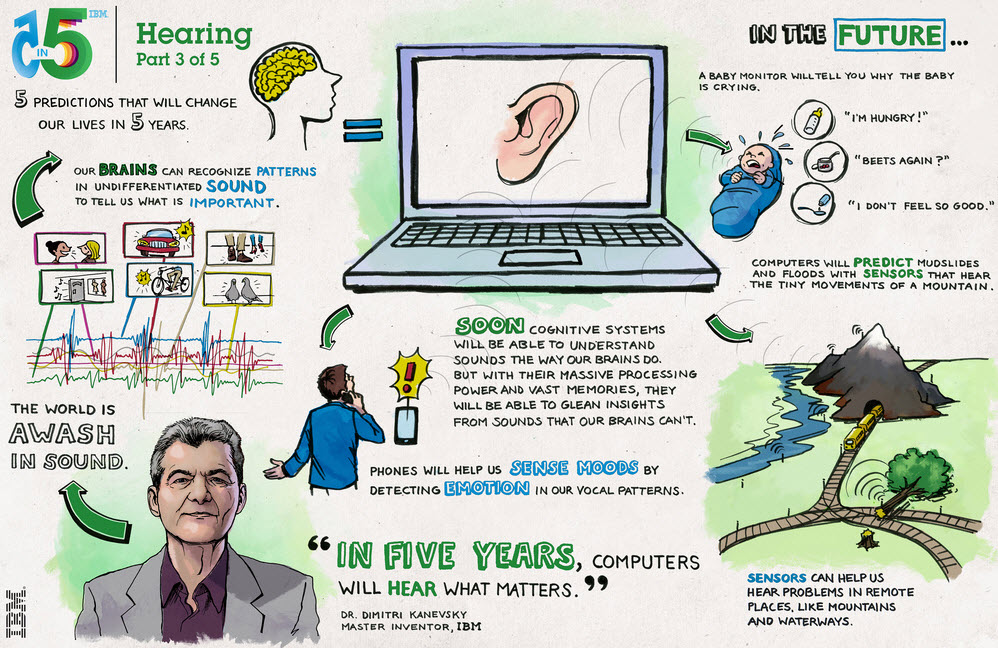
Within five years, a distributed system of clever sensors will detect elements of sound such as sound pressure, vibrations and sound waves
at different frequencies. It will interpret these inputs to predict
when trees will fall in a forest or when a landslide is imminent. Such a
system will “listen” to our surroundings and measure movements, or the
stress in a material, to warn us if danger lies ahead.
Raw sounds will be detected by sensors, much like the human brain. A
system that receives this data will take into account other modalities,
such as visual or tactile information, and classify and interpret the
sounds based on what it has learned. When new sounds are detected, the
system will form conclusions based on previous knowledge and the ability
to recognize patterns.
For example, “baby talk” will be understood as a language, telling
parents or doctors what infants are trying to communicate. Sounds can be
a trigger for interpreting a baby’s behavior or needs. By being taught
what baby sounds mean — whether fussing indicates a baby is hungry, hot,
tired or in pain — a sophisticated speech recognition system would
correlate sounds and babbles with other sensory or physiological
information such as heart rate, pulse and temperature.
In the next five years, by learning about emotion and being able to
sense mood, systems will pinpoint aspects of a conversation and analyze
pitch, tone and hesitancy to help us have more productive dialogues that
could improve customer call center interactions, or allow us to
seamlessly interact with different cultures.
For example, today, IBM scientists are beginning to capture underwater noise levels in Galway Bay, Ireland
to understand the sounds and vibrations of wave energy conversion
machines, and the impact on sea life, by using underwater sensors that
capture sound waves and transmit them to a receiving system to be
analyzed.\
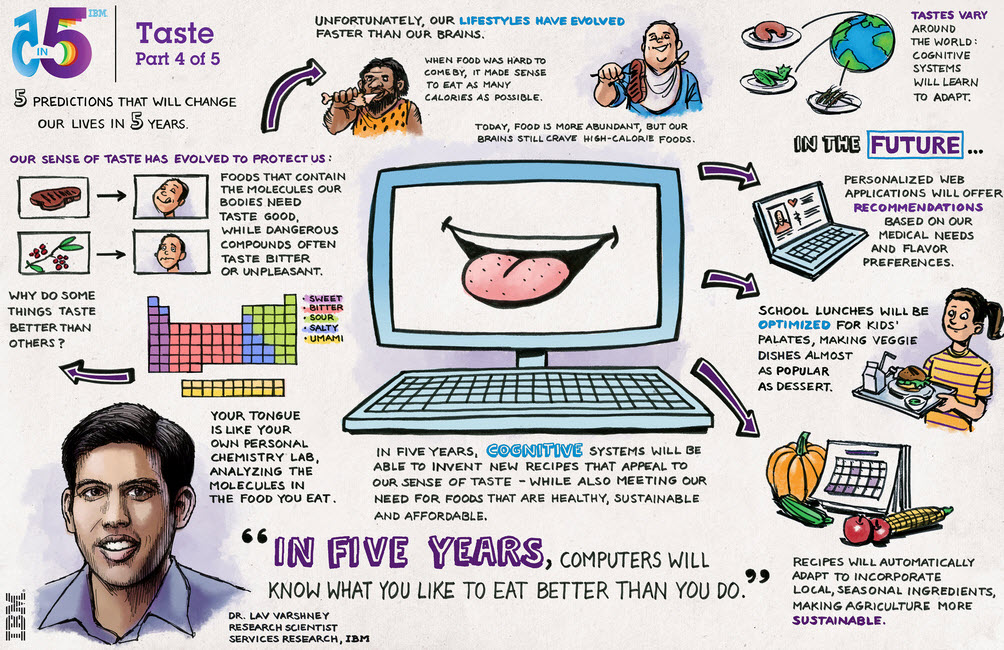
What if we could make healthy foods taste delicious using a different kind of computing system that is built for creativity?
IBM researchers are developing a computing system that detects
flavor, to be used with chefs to create the most tasty and novel
recipes. It will break down ingredients to their molecular level and
blend the chemistry of food compounds with the psychology behind what
flavors and smells humans prefer. By comparing this with millions of
recipes, the system will be able to create new flavor combinations that
pair, for example, roasted chestnuts with other foods such as cooked
beetroot, fresh caviar, and dry-cured ham.
A system like this can also be used to help us eat healthier,
creating novel flavor combinations that will make us crave a vegetable
casserole instead of potato chips.
The computer will be able to use algorithms to determine the precise
chemical structure of food and why people like certain tastes. These
algorithms will examine how chemicals interact with each other, the
molecular complexity of flavor compounds and their bonding structure,
and use that information, together with models of perception to predict
the taste appeal of flavors.
Not only will it make healthy foods more palatable — it will also
surprise us with unusual pairings of foods actually designed to maximize
our experience of taste and flavor. In the case of people with special
dietary needs, such as individuals with diabetes, it would develop
flavors and recipes to keep their blood sugar regulated, but satisfy
their sweet tooth.
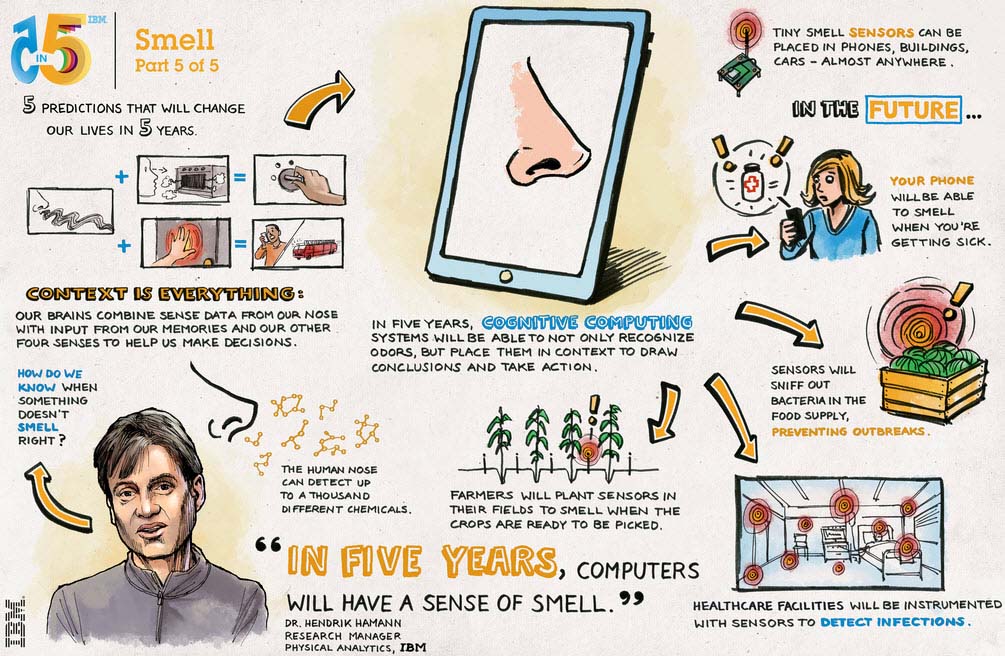
During the next five years, tiny sensors embedded in your computer or
cell phone will detect if you’re coming down with a cold or other
illness. By analyzing odors, biomarkers and thousands of molecules in
someone’s breath, doctors will have help diagnosing and monitoring the
onset of ailments such as liver and kidney disorders, asthma, diabetes
and epilepsy by detecting which odors are normal and which are not.
In the next five years, IBM technology will “smell” surfaces for
disinfectants to determine whether rooms have been sanitized. Using
novel wireless “mesh” networks, data on various chemicals will be
gathered and measured by sensors, and continuously learn and adapt to
new smells over time.
Due to advances in sensor and communication technologies in
combination with deep learning systems, sensors can measure data in
places never thought possible. For example, computer systems can be used
in agriculture to “smell” or analyze the soil condition of crops. In
urban environments, this technology will be used to monitor issues with
refuge, sanitation and pollution — helping city agencies spot potential
problems before they get out of hand.
Today IBM scientists are already sensing environmental conditions and gases to preserve works of art. This innovation is beginning to be applied to tackle clinical hygiene, one of the biggest challenges in healthcare today.
Antibiotic-resistant bacteria such as Methicillin-resistant
Staphylococcus aureus (MRSA), which in 2005 was associated with almost
19,000 hospital stay-related deaths in the United States, is commonly
found on the skin and can be easily transmitted wherever people are in
close contact. One way of fighting MRSA exposure in healthcare
institutions is by ensuring medical staff follow clinical hygiene
guidelines.
No comments:
Post a Comment