Dear Friends,
http://crowlspace.com/?p=1524
Be Well.
David
The Unknown Solar System

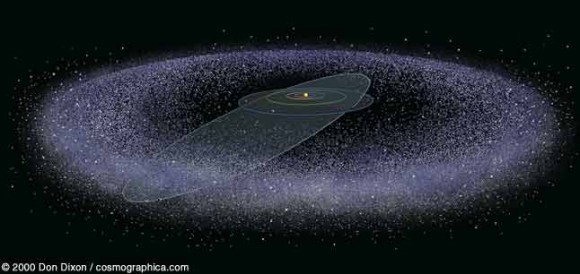
Just beyond Neptune is the Kuiper Belt, a torus of comet-like
objects, which includes a few dwarf-planets like the Pluto-Charon
dual-planet system. Despite being lumped together under one monicker,
the Belt is composed of several different families of objects, which
have quite different orbital properties. Some are locked in place by the
gravity of the big planets, mostly Neptune, while others are destined
to head in towards the Sun, while some show signs of being scattered
into the vastness beyond. Patryk Lykawka is a one researcher who has
puzzled over this dark, lonely region, and has tried to model exactly
how it has become the way it is today. Over the last two decades there
has been a slow revolution in our understanding of how the Big Planets,
the Gas Giants, formed. They almost certainly did not begin life in
their present orbits – instead they migrated outwards from a formation
region closer to the Sun. To do so millions of planetoids on near-misses
with the Gas Giants tugged them gently outwards over millions of years.
We know what happened to the Gas Giants, but what of the planetoids? A
fraction today form the Kuiper Belt and the Oort Cloud beyond it (how
many Plutos exist out there?) But a mystery remains, which Lykawka convincingly solves
in his latest monograph via an additional “Super-Planetoid”, a planet
between 0.3-0.7 Earth masses, now orbiting somewhere just beyond the
Belt.
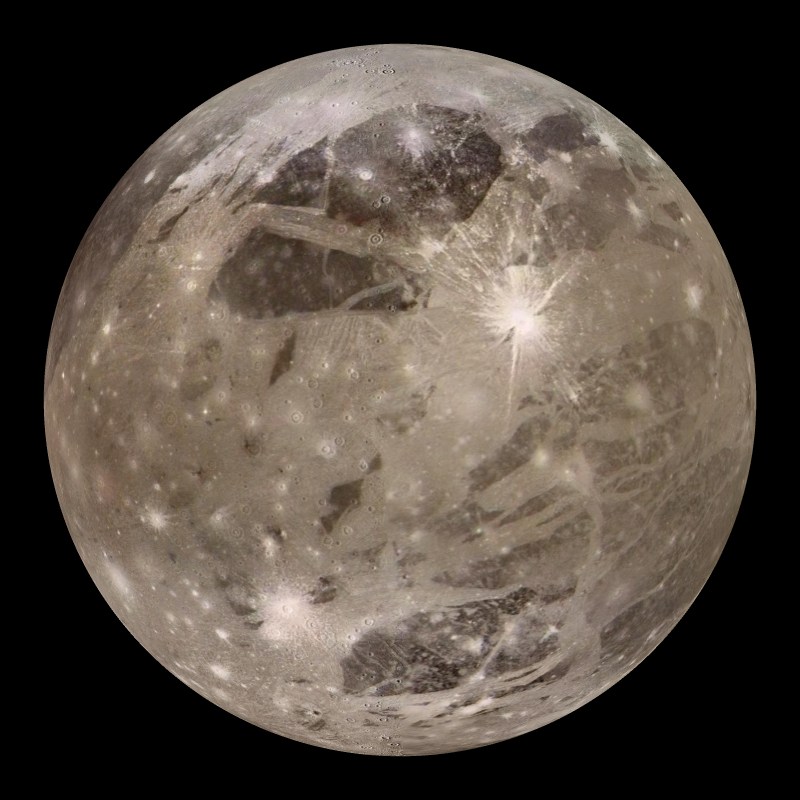
Such an object would be a sample of the objects that formed the Gas
Giants, a so-called “Planetary Embryo”. Based on the ice and silicate
mix present in the moons of the Gas Giants, the object would probably be
half ice, half silicates/metals, like a giant version of Ganymede.
However such an object would also have gained a significant atmosphere,
unlike smaller bodies, and being cast so far from the Sun, it would have
retained it even if it was composed of the primordial hydrogen/helium
mix of the Gas Giants themselves. This has two potentially very
interesting consequences. David Stephenson, in 1998, speculated on interstellar planets
with thick hydrogen atmospheres able to keep a liquid-water ocean warm
from geophysical heat-sources alone. Work by Eric Gaidos and Raymond
Pierrehumbert suggests hydrogen greenhouse planets
are a viable option in any system once past about ~2.0 AU. A
precondition that obtains for Lykawka’s hypothetical Super
Trans-Neptunian Object.
So instead of a giant Ganymede the object is more like Kainui,
from Hal Clement’s last novel, “Noise”. Kainui is a “hot Ganymede”, a
water planet with sufficiently low gravity that the global ocean hasn’t
been compressed into Ice VII in its very depths. Kainui’s ocean is in a
continual state of violent agitation, lethal to humans without special
noise-proof suits, but Lykawka’s Super-TNO would probably be wet beneath
its dense atmosphere, warmed by a trickle of heat from its core and the
distant Sun.

Gravitational perturbation studies of planetary orbits by Lorenzo Iorio constrain the orbital distance
of such a body to roughly where Lykawka suggests it should be. A
Mars-mass object (0.1 Earth-masses) would exist between 150-250 AU,
while a 0.7 Earth-mass body would be between 250-450 AU. If we place it
at ~300 AU, then its equilibrium temperature, based on sunlight alone,
would be somewhere below 16 K. That’s close to the triple-point of
hydrogen (13.84 K @ 0.0704 bar), suggesting a frozen planet would
result. However geophysical heat, from radioactive decay of potassium,
uranium and thorium, could elevate the equilibrium temperature to over
~20.4 K, hydrogen’s boiling point at 1 atm pressure. Thus a thick
hydrogen atmosphere should stay gaseous.
To keep liquid water warm enough (~273 K) at the surface, the surface
pressure will need to be ~1,000 bar, the equivalent of the bottom of
Earth’s oceans. An ammonia-water eutectic mixture would be liquid at
~100 bars and 176 K. With a higher rock fraction and higher radioactive
isotope levels (as seen in comets, for example), liquid water might be
possible at ~300 bars. Such a warm ocean would seem enticingly
accessible since a variety of submarines and ROVs operate in the ocean
at such pressures regularly. While the prospects for life seem dim, the
variety of chemosynthetic life-styles amongst bacteria suggest we
shouldn’t be too hasty about dismissing the possibility.
A primordial atmosphere also invites thoughts of mining the helium
for that rare isotope, helium-3. At 0.3 Earth masses and 1:3 ratio of
ice to rock, such a body has 75% Earth’s radius and just 40% the
gravitational potential at its surface – even less at the top of the
atmosphere. Such a planet would be incredibly straight-forward to mine
and condensing helium-3 out of the mix would be made even easier by the
~30-40 K temperature at the 1 bar pressure level. There’s no simple
relationship between the size of a planet and its spin rate, but
assuming Earth’s early spin rate of 12 hours, then the synchronous
orbital radius is just 2 Earth radii above the operating altitude of a
mining platform. A space-elevator system would be straight-forward to
implement, unlike the Gas Giants or even Earth.
Travelling to 300 AU is a non-trivial task, ten-times the distance to
Neptune. A minimum-energy Hohmann trajectory would take 923 years,
while a parabolic orbit would do the trip in 390 years. Voyager’s 15
km/s interstellar cruise speed would mean a trip of 95 years. A nuclear
saltwater rocket, with an exhaust velocity of 4,725 km/s, could be used
to accelerate to 3,000 km/s, then flip and brake at the destination. The
trip would take six months, which is speedy by comparison.
No comments:
Post a Comment