Dear Friends,
And what do U think happens when U eat these fish?
Psychiatric Drugs Changing
Fish Behavior
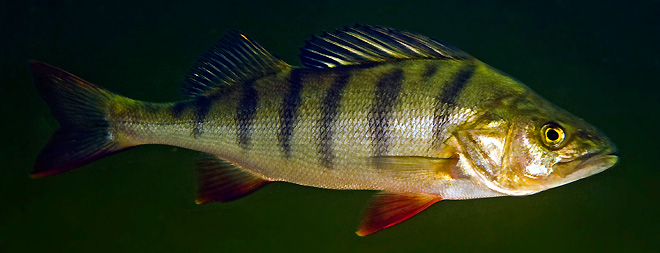
An European Perch, (Perca fluviatilis).
Image credit:
Image Courtesy of Bent Christensen
Rights information:
http://bit.ly/LDFc85
Pharmaceuticals are reaching waterways and affecting
the way fish act.
Originally published:
Feb 14 2013 - 2:00pm
By:
Ker Than, ISNS Contributor
(ISNS) -- Psychiatric medicines that are excreted by
humans and find their way into waterways can change the behavior of fish in
rivers and streams, scientists report in a new study.
Researchers found that wild European perch exposed to
the anxiety-moderating drug oxazepam in an experimental pond in Sweden were
less fearful and are more aggressive feeders.
Ecologists worry that such changes in fish behavior
could lead to unexpected ecological consequences, including changing the
composition of species in waterways and increasing the risk of potentially
toxic algal blooms.
"This is only one of hundreds of kinds of
[pharmaceutical drugs] that are passed through wastewater plants, and we don't
know what their environmental effects will be," said study coauthor Micael
Jonsson, an ecologist at Sweden's Umea University.
The new study, detailed in this week's issue of the journal Science,
also found that water downstream from sewage treatment plants in Sweden contain
concentrations of Oxazepam that experiments have shown are capable of changing
fish behavior.
The findings add to a growing body of evidence that
pharmaceutical drugs can do more than just poison fish or change their physical
characteristics. An earlier study conducted by scientists in Minnesota at St.
Cloud State University showed that fathead minnows exposed to various
antidepressants in the laboratory were slower at avoiding predators.
This latest study expands the list of mood altering
chemicals to a different class of drugs – those used to treat anxiety
disorders.
"Before this, people had talked at [scientific]
meetings about how you would expect this kind of drug to affect fish behavior,
but what these researchers have done is show, very elegantly, how fish behavior
has changed, and not just one aspect either, but several aspects," said
Patrick Phillips, a hydrologist with the U.S. Geological Survey in Troy, N.Y.,
who was not involved in the study.
Perch are normally shy and hunt in schools. But
Jonsson and his team found that those exposed to Oxazepam were bolder, less
interested in hanging out with the group, and more likely to strike out on
their own to explore novel, potentially dangerous areas.
"We were actually a bit surprised because
[Oxazepam] is supposed have a soothing effect. Humans usually become calmer.
But we saw the opposite in fish," Jonsson said.
Normally, perch are constantly on the lookout for
larger predator fish. The researchers speculate that the medicated perch are
bolder because they are calmer.
"When they get exposed to this drug, they lose
that inhibition, so they don't care anymore," Jonsson said.
Not only were the medicated perch braver, they also
ate faster. In the long term, this combination of fearlessness and a larger
appetite could lead to ecological disturbances that are hard to predict,
scientists warn. Perch feed on tiny microorganisms called zooplankton, which in
turn feed on algae.
"If the zooplankton decrease in number, the algae
might increase, and you could have a situation where you have more algal
blooms," Jonsson said.
Alternatively, the perch population might actually
decrease because drugs have made them foolhardy towards predators. But then
again, "we don't know how larger fish will react to this kind of
medication," Jonsson said.
There is also worry that some drug effects on wildlife
won't be apparent for years or decades.
"We're just beginning to understand what the
ultimate consequences may be from these kinds of exposures," said research
hydrologist Dana Kolpin, of the USGS Toxics Substances Hydrology Program, who
also did not participate in the study.
According to scientists, it's also likely that the
ecological changes they worry about are already happening.
"It's not all of a sudden that [medicines] are in
the environment," Kolpin said. "There are papers going back to the
1970s that say pharmaceuticals are potential environmental contaminants. We
just didn't have the analytical tools until more recently [to prove it]."
Most studies have shown that humans are unlikely to be
affected by trace amounts of drugs in drinking water, but Kolpin suggests more
research is needed.
"We just do not know enough about aspects such as
sensitive populations" – including infants and pregnant women – "or
effects from chronic exposures to complex chemical mixtures," Kolpin said.
Jonsson and his team stressed that the solution to the
problem is not to stop medicating ill people, but to develop ways for sewage
treatment plants to capture environmentally hazardous drugs.
Experts say technology exists that can reduce, if not
fully purge, drugs from waste water, but upgrading every waste treatment plant would
be prohibitively expensive.
A more sensible, and realistic, approach would be to
identify those classes of medicines that are most harmful to wildlife.
"We are realizing that some compounds are worse
actors than others, and if we can identify those, then we can be more targeted
in our approach for preventing their release into the environment," Kolpin
said.
Ker Than is a freelance writer based in Southern
California.
No comments:
Post a Comment