Dear Friends,
Be Well.
David
Building Unbreakable Codes Beyond
The Bounds Of Earth
Rights information:
http://bit.ly/QafmwK
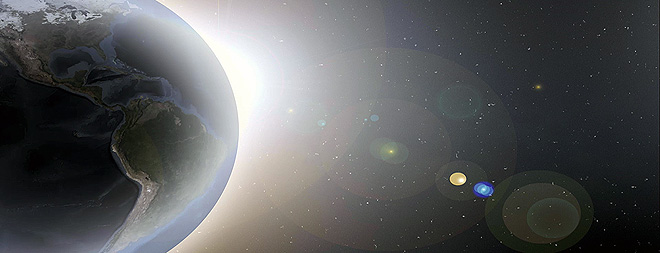
Quantum satellites may beam down powerful data
encryption keys.
Originally published:
Mar 13 2013 - 1:30pm
By:
Joel N. Shurkin, ISNS Contributor
(ISNS) -- Scientists are pushing to create a space-based
quantum communications network that could enable impossible-to-monitor
transmissions.
In doing so, they might make it possible for someone
named Scotty to really teleport some information into space.
It would be enough "to spook" Albert
Einstein, said Thomas Jennewein of the University of Waterloo in Ontario, one
of the top researchers in the field.
The encryption research could have immediate practical
implications. The process would make use of entangled photons, what
Einstein--who resisted the consequences of quantum theory until his death
--called "spooky action at a distance."
"If we can use correlations between entangled
photons to establish a quantum key, it could be used for secure
communications," said Jennewein.
Einstein and two colleagues theorized in 1935 that if
you had two quantum systems that interacted, such as two atoms in a molecule,
and then separated them, they would remain entangled, meaning their properties
would be inextricably linked. Measuring one atom would instantly produce a
change in the other no matter how far apart they were.
Einstein believed that there was a universal speed
limit: nothing could travel faster than light so he thought such
communication—"spooky action"—would be impossible.
But in 1972, a group of U.S. scientists showed that is
exactly what happens, at least over the short distances of their laboratory
experiment.
Decades before, another physics giant, Werner
Heisenberg, proposed in his famous uncertainty principle that merely observing a particle or otherwise disturbing
it changes its properties, and--according to quantum theory--so instantly would
that of its entangled twin.
Common encryption involves using keys, series of
numbers, and letters that code and decode messages. The sender has one key that
encrypts the message; the person receiving the message has another which
decodes it.
Scientists can envision sending beams of quantum
signals from one place to another to produce encryption keys, but there is a
problem.
Quantum communications signals have not been able to
travel very far on Earth. The current record is 89 miles set in the Canary
Islands by Jennewein and a team, then of the University of Vienna. The problem
is transmission loss or scattering in the atmosphere.
Even using fiber-optic cables is not the answer,
according to Joshua Bienfang, at the National Institute of Standards and
Technology, another expert in the field. The chances of a single photon
traveling safely more than around 250 miles in a fiber-optic cable is slim, he
said.
That's why Jennewein and other researchers are looking
to space, where the beams would not scatter in the vacuum. His lab, among
others, now has produced a design for such satellites that would test that out.
Jennewein describes a system in which a device in a
satellite creates entangled photon pairs and simultaneously transmits one of
each pair to two ground stations in beams of millions of photons, all in
entangled quantum states. That means both stations should have the same key.
The two stations would compare them. If the
transmissions were not intercepted or modified by an eavesdropper, the two keys
should be identical. The sender can then send a conventionally encrypted
message secure in the knowledge no one is listening.
But, if there is any alteration in the keys, which
would happen if anyone intercepted the key message, Heisenberg's theory would
strike, and the photons would be altered. The two parties would know if there
was an eavesdropper and either resend the keys or try another system.
Several corporations and government research
facilities around the world are working on similar satellite systems.
"Moreover, long-distance 'quantum teleportation'
experiments could be conducted--the first baby steps towards realizing the
famous Star Trek 'Beam me up, Scotty' command may be only a few years
away," Jennewein wrote in the magazine "Physics World." In quantum
teleportation, actual objects themselves are not beamed up. Instead, their
information—encoded in a quantum state—would vanish from a particle on Earth
and then reappear in a particle in space.
The scheme would require three photons, Jennewein
said. One, the input photon, to be teleported, and two others, entangled and
separated.
"The input photon is correlated with one of the
entangled ones, and thereby its quantum state is fully transferred onto the
other entangled photon, which can be at a distance," Jennewein said.
"The final photon is the new 'original,' and the initial photons
completely lose their information."
An additional benefit of developing a quantum
satellite system is that it would enable physicists to test quantum theory over
much greater distances.
Joel Shurkin is a freelance writer based in Baltimore.
He is the author of nine books on science and the history of science, and has
taught science journalism at Stanford University, UC Santa Cruz and the
University of Alaska Fairbanks.
No comments:
Post a Comment