The
Forgotten Female Programmers Who Created Modern Tech
by LAURA SYDELL
6
min 46 sec

Jean
Jennings (left) and Frances Bilas set up the ENIAC in 1946. Bilas is arranging
the program settings on the Master Programmer.
Courtesy
of University of Pennsylvania
If your
image of a computer programmer is a young man, there's a good reason: It's
true. Recently, many big tech companies revealed how few of their female employees
worked in programming and technical jobs. Google had some of the highest rates:
17 percent of its technical staff is female.
It
wasn't always this way. Decades ago, it was women who pioneered computer
programming — but too often, that's a part of history that even the smartest
people don't know.
I took a
trip to ground zero for today's computer revolution, Stanford University, and
randomly asked over a dozen students if they knew who were the first computer
programmers. Almost none knew.
"I'm
in computer science," says a slightly embarrassed Stephanie Pham.
"This is so sad."
A few
students, like Cheng Dao Fan, get close. "It's a woman, probably,"
she says searching her mind for a name. "It's not necessarily [an]
electronic computer. I think it's more like a mechanic computer."
She's
thinking of Ada Lovelace, also known as the Countess of Lovelace, born in 1815.
Walter Isaacson begins his new book, The Innovators: How a Group
of Hackers, Geniuses and Geeks Created the Digital Revolution, with her
story.
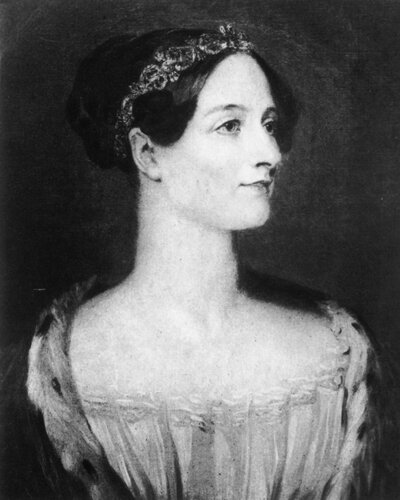
Augusta
Ada, Countess of Lovelace, was the daughter of poet Lord Byron. The computer
language ADA was named after her in recognition of her pioneering work with
Charles Babbage.
Hulton
Archive/Getty Images
"Ada
Lovelace is Lord Byron's child, and her mother, Lady Byron, did not want her to
turn out to be like her father, a romantic poet," says Isaacson. So Lady
Byron "had her tutored almost exclusively in mathematics as if that were
an antidote to being poetic."
Lovelace
saw the poetry in math. At 17, she went to a London salon and met Charles
Babbage. He showed her plans for a machine that he believed would be able to do
complex mathematical calculations. He asked Lovelace to write about his work
for a scholarly journal. In her article, Lovelace expresses a vision for his
machine that goes beyond calculations.
She
envisioned that "a computer can do anything that can be noted
logically," explains Isaacson. "Words, pictures and music, not just
numbers. She understands how you take an instruction set and load it into the
machine, and she even does an example, which is programming Bernoulli numbers,
an incredibly complicated sequence of numbers."
Babbage's
machine was never built. But his designs and Lovelace's notes were read by
people building the first computer a century later.
The
women who would program one of the world's earliest electronic computers,
however, knew nothing of Lovelace and Babbage.
As part of the oral history project of the
Computer History Museum, Jean
Jennings Bartik recalled how she got the job working on that computer. She was
doing calculations on rocket and cannon trajectories by hand in 1945. A job
opened to work on a new machine.
"This
announcement came around that they were looking for operators of a new machine
they were building called the ENIAC," recalls Bartik. "Of course, I
had no idea what it was, but I knew it wasn't doing hand calculation."
Bartik
was one of six female mathematicians who created programs for one of the
world's first fully electronic general-purpose computers. Isaacson says the men
didn't think it was an important job.
"Men
were interested in building, the hardware," says Isaacson, "doing the
circuits, figuring out the machinery. And women were very good mathematicians
back then."
Isaacson
says in the 1930s female math majors were fairly common — though mostly they
went off to teach. But during World War II, these skilled women signed up to
help with the war effort.
Bartik told a live audience at the Computer
History Museum in 2008 that the
job lacked prestige. The ENIAC wasn't working the day before its first demo.
Bartik's team worked late into the night and got it working.
"They
all went out to dinner at the announcement," she says. "We weren't
invited and there we were. People never recognized, they never acted as though
we knew what we were doing. I mean, we were in a lot of pictures."
At the
time, though, media outlets didn't name the women in the pictures. After the
war, Bartik and her team went on to work on the UNIVAC, one of the first major
commercial computers.
The
women joined up with Grace Hopper, a tenured math professor who joined the Navy
Reserve during the war. Walter Isaacson says Hopper had a breakthrough. She
found a way to program computers using words rather than numbers — most notably
a program language called COBOL.
"You
would be using a programming language that would allow you almost to just give
it instructions, almost in regular English, and it would compile it for
whatever hardware it happened to be," explains Isaacson. "So that
made programming more important than the hardware, 'cause you could use it on
any piece of hardware."

Grace
Hopper originated electronic computer automatic programming for the Remington
Rand Division of Sperry Rand Corp.
AP
Hopper
retired from the Navy Reserve as a rear admiral. An act of Congress allowed her
to stay past mandatory retirement age. She did become something of a public
figure and even appeared on the David Letterman show in
1986. Letterman asks her, "You're known as the Queen of software.
Is that right?"
"More
or less," says the 79-year-old Hopper.
But it
was also just about this time that the number of women majoring in computer
science began to drop, from close to 40 percent to around 17 percent now. There
are a lot of theories about why this is so. It was around this time that Steve
Jobs and Bill Gates were appearing in the media; personal computers were taking
off.
Computer
science degrees got more popular, and boys who had been tinkering with computer
hardware at home looked like better candidates to computer science departments
than girls who liked math, says Janet Abbate, a professor at Virginia Tech who
has studied this topic.
"It's
kind of the classic thing," she says. "You pick people who look like
what you think a computer person is, which is probably a teenage boy that was
in the computer club in high school."
For
decades the women who pioneered the computer revolution were often overlooked,
but not in Isaacson's book about the history of the digital
revolution.
"When
they have been written out of the history, you don't have great role
models," says Isaacson. "But when you learn about the women who
programmed ENIAC or Grace Hopper or Ada Lovelace ... it happened to my
daughter. She read about all these people when she was in high school, and she
became a math and computer science geek."
Lovelace,
the mathematician, died when she was 36. The women who worked on the ENIAC have
all passed away, as has Grace Hopper. But every time you write on a computer,
play a music file or add up a number with your phones calculator, you
are using tools that might not exist without the work of these women.
Isaacson's book reminds
us of that fact. And perhaps knowing that history will show a new generation of
women that programming is for girls.

How a
Group of Hackers, Geniuses, and Geeks Created the Digital Revolution
Hardcover,
528 pagespurchase
More
on this book:
No comments:
Post a Comment