Extraterrestrial Artifacts In Our
Solar System Could Exist And Observe Us – Scientists Say
MessageToEagle.com – If you are a science fiction fan, then
you have most likely read the book or seen the movie 2001: A
Space Odyssey.
You will know that the discovery of an alien
mysterious black monolith buried beneath the Lunar surface is the beginning of
a great space adventure. The discovery of alien artifacts in our cosmic
neighborhood would be one of the biggest events in the history of humankind.
The name derives from Greek “xenos”, which means
‘stranger, alien’, and archaeology ‘study of ancients’.
On the Moon we humanity has already registered the
remains of the Apollo 11 mission in the so-called Sea of Tranquility as a
“Historical Resource.”
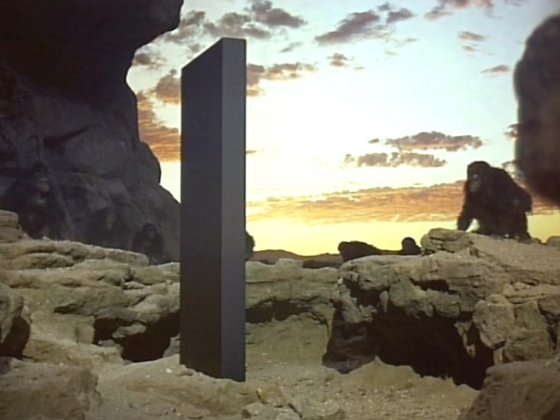
In Arthur C. Clarke’s book 2001: A Space Odyssey the
discovery of an artifical monolith on the Moon is the beginning of a
fascinating space adventure.
“It’s about time that we acknowledged the importance
of these sites for mankind,” says Beth O’Leary, an anthropologist at New Mexico
State University and the co-founder of the Lunar Legacy Project.
O’Leary and her colleagues have compiled a map
identifying the items left at the landing site, as well as a comprehensive list
of Apollo’s junk.
Space archaeologists are worried that future missions,
or possibly moon tourists, could loot and even destroy this sacred site of
earth history.
“Can you imagine someone driving a cart over Neil
Armstrong’s first footprint?” warns Peter Capelotti, an anthropologist at Penn State
University in Abington, Pennsylvania.
The artifacts of human missions to the moon and Mars
are urgently in need of official protection, says Capelotti, “Otherwise we must
be prepared to someday see pieces of Apollo 11 listed for sale on eBay.”

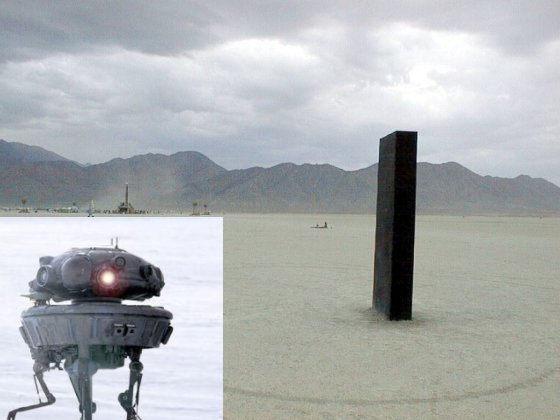
Where would extraterrestrials place alien artifacts or
probes? Image credit: Lucas film
Scientists point out we should also not dismiss the
possibility that ET artifacts could exists close to our planet and some alien
devices might even observe us. One of the reasons we have not found such alien
artifacts is because we have not looked in all places, scientists from the Penn
State University say.
“The vastness of space, combined with our limited
searches to date, implies that any remote unpiloted exploratory probes of
extraterrestrial origin would likely remain unnoticed,” said Jacob Haqq-Misra,
Rock Ethics Institute, and Ravi Kumar Kopparapu, Earth and Environmental
Systems Institute.
So far, we have not found any non-terrestrial
artifacts in our solar system. The Fermi paradox, originally formulated by
Enrico Fermi, asks, if intelligent life is common, why no technological
civilizations have been observed.
Answers to this question could include life is rare,
intelligent cultures inevitably destroy themselves, intelligent beings have not
gotten here yet or they are here but not revealing themselves. Even without
actual contact, like us, other civilizations could be sending unpiloted probes
to quietly peek at our civilization.
These probes, like ours, would be small and might be
hidden in a variety of places. In the asteroid belt they would probably go
unnoticed, especially if these nonterrestrial objects are only 3 to 33 feet in
size, weighing little more than a ton.
“Extraterrestrial artifacts may exist in the solar
system without our knowledge simply because we have not yet searched
sufficiently,” said Haqq-Misra and Kopparapu. “Few if any of the attempts would
be capable of detecting a 1 to 10 meter (3 to 33 foot) probe.”
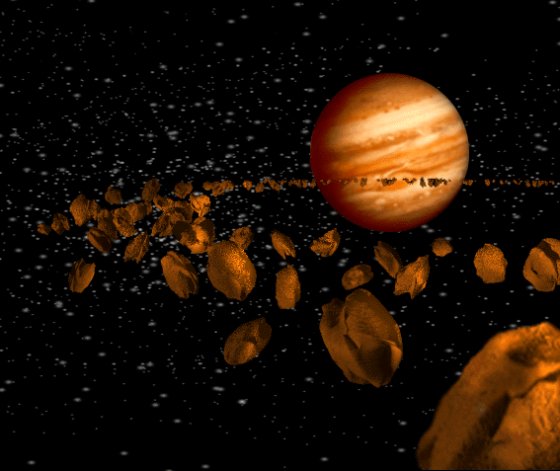
The asteroid belt is a perfect hiding place for alien
artifacts. Image credit: NASA
Haqq-Misra and Kopparapu use a probabilistic method to
determine if we have looked closely enough anywhere in the solar system to
definitively say there are no non-terrestrial objects here. The analysis is
based on answering the question: How sure can we be that we should have already
found any non-terrestrial objects lurking in the solar system?
They view the solar system as a fixed volume and
figure out the percentages of that volume that would need to be thoroughly
searched using a discovery capability small enough to detect these probes,
assuming that the probes are not consciously camouflaged. The researchers note
that most searches to date have not been fine enough to locate such small
probes or to totally rule out anywhere.
After taking into account a variety of potential
biases, such as “the universe is teeming with life” or “life is rare,” the team
developed an equation that can be applied to a portion of the volume of the
solar system and determine whether sufficient searching has been done to ensure
that we can say there are no non-terrestrial objects within that volume.
The researchers found that it is, at this point,
difficult to say that there are not nonterrestrial objects in our solar system.
“The surface of the Earth is one of the few places in
the solar system that has been almost completely examined at a spatial
resolution of less than 3 feet,” said Haqq-Misra and Kopparapu.
But even as humans have spread across the solid
surfaces of the Earth, there are still caves, jungles and deserts as well as
the ocean floor and subsurface areas that have not been explored. Even with
this, the Earth does have a high confidence that no nonterrestrial artifacts
exist.
The moon and Mars have been searched to a small
extent. An ongoing mapping project, the Lunar Reconnaissance Orbiter, is
looking at the moon at a resolution of about 20 inches, so we may eventually be
able to determine if there are no non-terrestrial objects on the moon. The
researchers caution that surface maps may not be sufficient to distinguish
between a space probe and a rock.
The surface of Mars is still mostly unsurveyed and the
researchers’ confidence in the probability of no non-terrestrial artifacts is
low. Similarly, locations like the Earth-moon Lagrange points, the asteroid
belt and the Kuiper belt might also shelter extra solar system probes, but the
vast majority of the solar system’s volume is uninvestigated.
“Searches to date of the solar system are sufficiently
incomplete that we cannot rule out the possibility that non-terrestrial
artifacts are present and may even be observing us,” said Haqq-Misra and
Kopparapu.
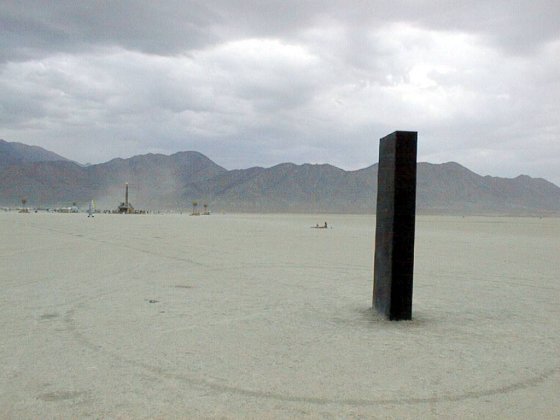
Will we one day find such monoliths on alien planets?
The researchers also said that “the completeness of
our search for non-terrestrial objects will inevitably increase as we continue
to explore the moon, Mars and other nearby regions of space.”
Just because we haven’t yet found any ET artifacts
doesn’t mean they do not exist. An alien probe could even orbit our planet and
monitor everything it happens here without our knowledge of its existence. Not
to mention the possibility that an alien message can be implanted in your DNA.
Extraterrestrial technology can be so advanced that it is undetectable to us,
byt that should not discourage us.
We need to keep searching…
Copyright ©
MessageToEagle.com. All rights
reserved. This material may not be published, broadcast, rewritten or
redistributed in whole or part without the express written permission of
MessageToEagle.com
Read more: http://www.messagetoeagle.com/extraterrestrial-artifacts-in-our-solar-system-could-exist-and-observe-us-scientists-say/#ixzz3lhikNWtg
No comments:
Post a Comment