Hints on how to
perceive the comet’s gradual motion across the sky as it sweeps closest – but
not too close – around January 17.
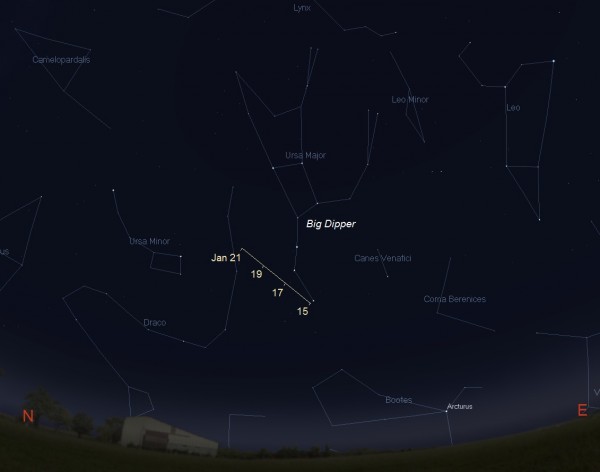
View larger. | Facing northeast beginning around 1 a.m. local
time – the time on your clock from most parts of the globe – until sunrise from
January 15 to 21, 2016. Comet Catalina passes very close to the stars that form
the Big Dipper as it nears its closest point to Earth. Illustration by Eddie
Irizarry using Stellarium.
UPDATE JANUARY 14, 2016: Comet C/2013 US10 (Catalina) will pass nearest
to Earth at a very safe distance this weekend, on January 17. At its closest,
the comet will be some 68 million miles (110 million km) from Earth. It isn’t
visible to the eye alone, but binoculars should reveal it as a small fuzzy
patch of light in the sky after midnight and before dawn. If you have a small
telescope, this comet will make a fantastic target. Although the actual movement
of the comet is difficult to perceive in real time because of its distance, you
should be able to see that the comet has shifted its position, over perhaps a
quarter of an hour, through a telescope. With your ‘scope, take a good look at
the comet as well as stars in the vicinity of this celestial visitor. Try
making a simple sketch of the comet’s location relative to nearby stars. Then,
look again through the telescope eyepiece about 15 or 20 minutes later, and you
will clearly see Comet Catalina has changed position!

