Hints on how to
perceive the comet’s gradual motion across the sky as it sweeps closest – but
not too close – around January 17.
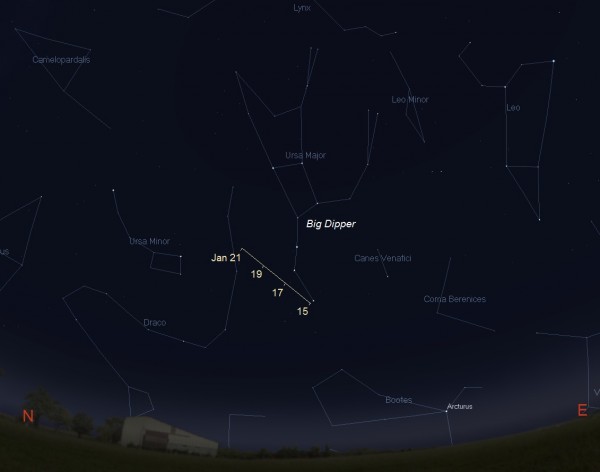
View larger. | Facing northeast beginning around 1 a.m. local
time – the time on your clock from most parts of the globe – until sunrise from
January 15 to 21, 2016. Comet Catalina passes very close to the stars that form
the Big Dipper as it nears its closest point to Earth. Illustration by Eddie
Irizarry using Stellarium.
UPDATE JANUARY 14, 2016: Comet C/2013 US10 (Catalina) will pass nearest
to Earth at a very safe distance this weekend, on January 17. At its closest,
the comet will be some 68 million miles (110 million km) from Earth. It isn’t
visible to the eye alone, but binoculars should reveal it as a small fuzzy
patch of light in the sky after midnight and before dawn. If you have a small
telescope, this comet will make a fantastic target. Although the actual movement
of the comet is difficult to perceive in real time because of its distance, you
should be able to see that the comet has shifted its position, over perhaps a
quarter of an hour, through a telescope. With your ‘scope, take a good look at
the comet as well as stars in the vicinity of this celestial visitor. Try
making a simple sketch of the comet’s location relative to nearby stars. Then,
look again through the telescope eyepiece about 15 or 20 minutes later, and you
will clearly see Comet Catalina has changed position!
Due to its distance, the comet appears to move slowly across the sky.
However, it is traveling through space at an astounding speed of 132,000 miles
per hour (212,433 km/h).
In the coming days, the comet is passing near on the sky’s dome to the
stars that form the Big Dipper. Current brightness estimates put Comet Catalina
at a magnitude 6.2 to 6.4, just below the level for viewing with the unaided
eye, but visible in binoculars, and a fine object for a small telescope. Try
looking in the wee hours after midnight, or before sunrise.
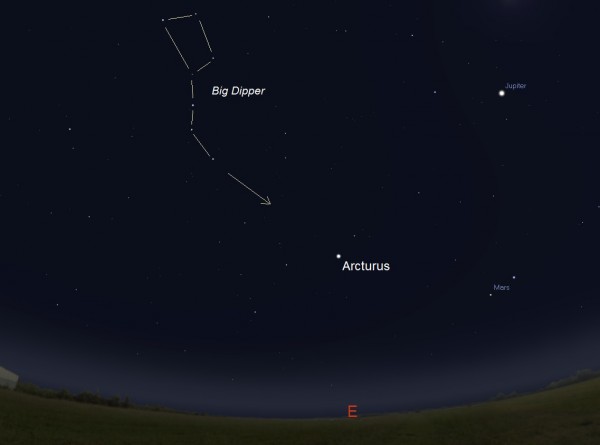
Facing east beginning around 4:30 a.m. local time until sunrise in early
January. Notice that the stars that form the Big Dipper’s handle point to the
bright orange or reddish star Arcturus. Before sunrise on January 9, Comet
Catalina will be located at the tip of the arrow. Illustration
by Eddie Irizarry using Stellarium.
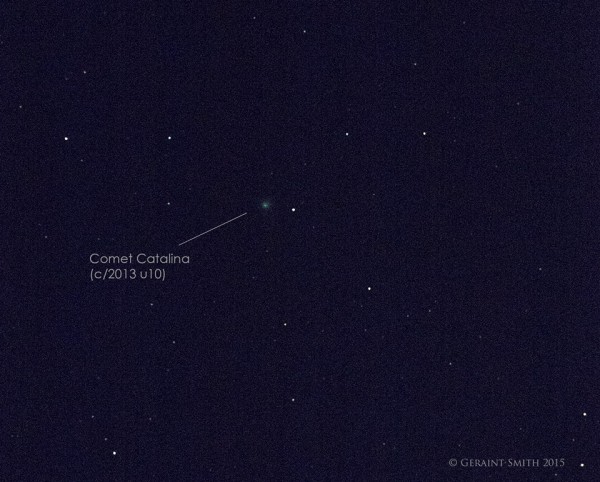
Comet Catalina on December 7 by Geraint Smith in New Mexico.
When and where
should I begin to look? The
comet is still primarily in our morning sky. By 1 a.m., it’s up above the
northeastern horizon.
Its brightness has been pretty steady, and, by all reports, Comet
Catalina has never risen above magnitude 6, the limit of visibility to the
unaided eye. But it has hovered just below that limit.
The moon is back in the evening sky now and has left the morning sky
dark. That’s good! If you go to a location far from city lights, you should be
able to sweep with your binoculars and find this comet.
The comet was closest to the sun on November 15, 2015, so it is moving
away from the sun now. On January 17, 2016, Comet Catalina will be at its
closest point to Earth, about some 68 million miles (110 million km) away.
That’s in contrast to the moon’s distance of about a quarter million miles … so
you can see the comet will come nowhere near us.
Remember – because it’s relatively close to us in contrast to the star
background – the comet is moving slowly across our sky’s dome. When the comet
is closest, you should be able to detect this motion through the eyepiece of
your telescope in about 15 or 20 minutes.
Want a more detailed chart? Or check out this chart from skyandtelescope.com.
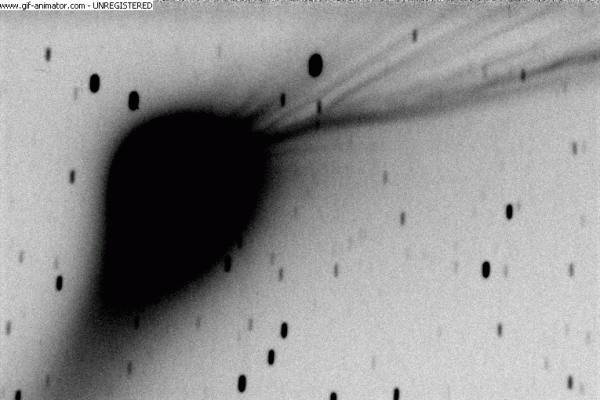
Comet Catalina images taken December 4, 2015 by Doug Durig. Here, you
can see some detail in the comet’s tail …
What will Comet
Catalina look like? The
comet’s tail has been some 500,000 miles (800,000 km) long! And it has shown a
double tail. Some photos have captured even more detail. With binoculars,
though, you’re likely to spot the comet as a small, circular, hazy patch. You
might see at most a short tail for this comet. It’s likely you won’t see any
color at all.
Telescopes will provide a better view. Even while observing visually
with a telescope, you will not see the green color of the comet, as shown some
photos. That color is mainly seen in pictures of this comet, and many comets.
Cameras are more sensitive than the human eye and after a few seconds or
minutes of exposure, they provide very good views of the colors that exist in
comets.
But visual observers using telescopes in December, 2015, might be able
to glimpse a hint of Comet Catalina’s green coma or cometary atmosphere.
And, by the way, the green color we see in comets is from gases like
diatomic carbon.
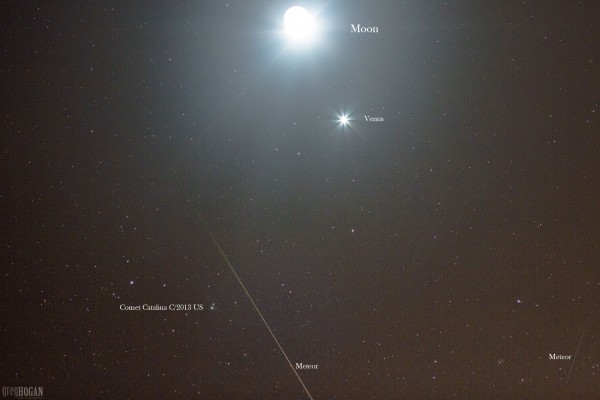
View larger. | Greg Hogan in Kathleen, Georgia caught this
photo on December 7, 2015. He wrote: “So what are the odds? I was going through
the images from Dec 7th and noticed that in one of the shots there was two
meteors! One was the tail end of a bright one, and one is faint. I saw some
large bright ones that morning but was not sure if they were in the frame. It
seems part of one was.”
Here are some
important dates.
October 31, 2013. The
Catalina Sky Survey in Arizona discovered a comet, later called C/2013 US10
(Catalina). At first, astronomers thought it was a rocky or metallic asteroid,
but further observations confirmed it as an icy comet.
November 15, 2015. Comet
Catalina was at perihelion or closest to the sun. It did not come as close to
the sun as some comets do. At closest approach to our star, the comet was
moving between the orbits of planets Earth and Venus. Its perihelion distance
was 0.82 AU from the sun (1 AU = 1 Earth-sun distance). Comet Catalina was
traveling at a speed of 103,000 miles per hour (166,000 km/h) relative to the
sun at perihelion.
November 23 to 30,2015. Comet Catalina became visible for Northern Hemisphere observers.
December 7,2015. Sky
show! Comet Catalina was visible close to Venus and the waning moon.
December 31,2015. Comet
will be approaching the apparent position of the star Arcturus on our sky’s
dome. Another good photo opportunity.
January 1,2016. Comet
Catalina will be passing very close to star Arcturus. An excellent reference to
finding the comet in the sky!
January 17,2016. Comet
Catalina will pass some 68 million miles (110 million km) from Earth. That’s
very, very far from Earth – hundreds of times farther than the moon’s distance.
So there is no danger of a collision. That said, let’s talk about the size of
the comet’s nucleus or core. Some estimates indicate the nucleus of Comet
Catalina ranges between 4 and 20 kilometers in diameter.
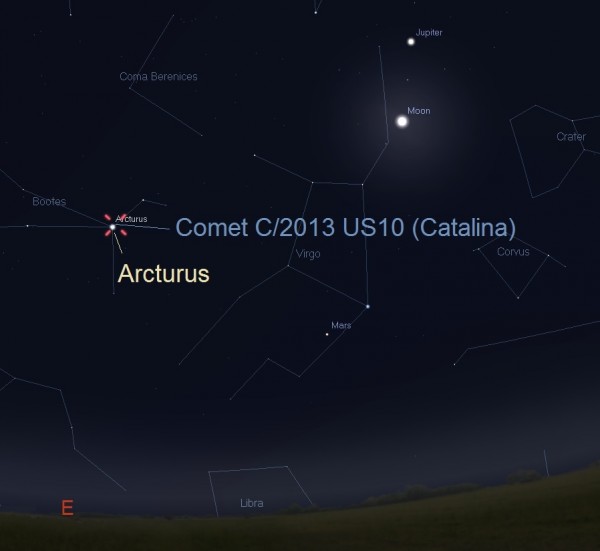
January 1, 2016, from 2 a.m. to sunrise, local time. The comet will be
very near the bright star Arcturus in the constellation Bootes. Photo
opportunity!
When is the next
predicted comet visible to the eye alone? The next predicted comet that may be reach visibility to the
unaided eye – and be really easy to spot – is Comet 46P/Wirtanen. It will
appear as a sky gift for Christmas of 2018.
Although Comet 46P may show a magnitude of 3 or 4, there is always the
possibility that a newly found comet will provide a good celestial show prior
to that time.
Bottom line: Comet C/2013 US10 (Catalina) is now visible in binoculars,
in December, 2015. When and where to look, what to expect, some important dates
to remember.
By courtesy of Maya Benmergui
No comments:
Post a Comment