
Dear Friends,
http://www.kurzweilai.net/global-trends-2030-alternative-worlds?utm_source=KurzweilAI+Daily+Newsletter&utm_campaign=75bb0dfaab-UA-946742-1&utm_medium=email
Be Well.
David
http://www.kurzweilai.net/global-trends-2030-alternative-worlds?utm_source=KurzweilAI+Daily+Newsletter&utm_campaign=75bb0dfaab-UA-946742-1&utm_medium=email
Be Well.
David
Global Trends 2030: Alternative Worlds
December 12, 2012
The National Intelligence Council has issued Global Trends 2030: Alternative Worlds,
“intended to stimulate thinking about the rapid and vast geopolitical
changes characterizing the world today and possible global trajectories
during the next 15-20 years.”
The report sees four megatrends:
Individual empowerment will accelerate substantially
during the next 15-20 years owing to poverty reduction and a huge
growth of the global middle class, greater educational attainment,
better health care, and widespread exploitation of new communications
and manufacturing technologies. Enabled by communications technologies,
power will shift toward multifaceted and amorphous networks that will
form to influence state and global actions.
Diffusion of power among countries will have a
dramatic impact by 2030. Asia will have surpassed North America and
Europe combined in terms of global power, based upon GDP, population
size, military spending, and technological investment. China alone will
probably have the largest economy, surpassing that of the United States a
few years before 2030.
Demographic Patterns: in the world of 2030—a world
in which a growing global population will have reached somewhere close
to 8.3 billion people (up from 7.1 billion in 2012)—four key trends will
be aging—a shrinking number of youthful societies and states;
migration, which will increasingly be a cross-border issue; and growing
urbanization, which will spur economic growth but could put new strains
on food and water resources.
Growing Food, Water, and Energy Nexus: Demand for
food, water, and energy will grow by approximately 35, 40, and 50
percent respectively owing to an increase in the global population and
the consumption patterns of an expanding middle class. Climate change
will worsen the outlook for the availability of these critical
resources.
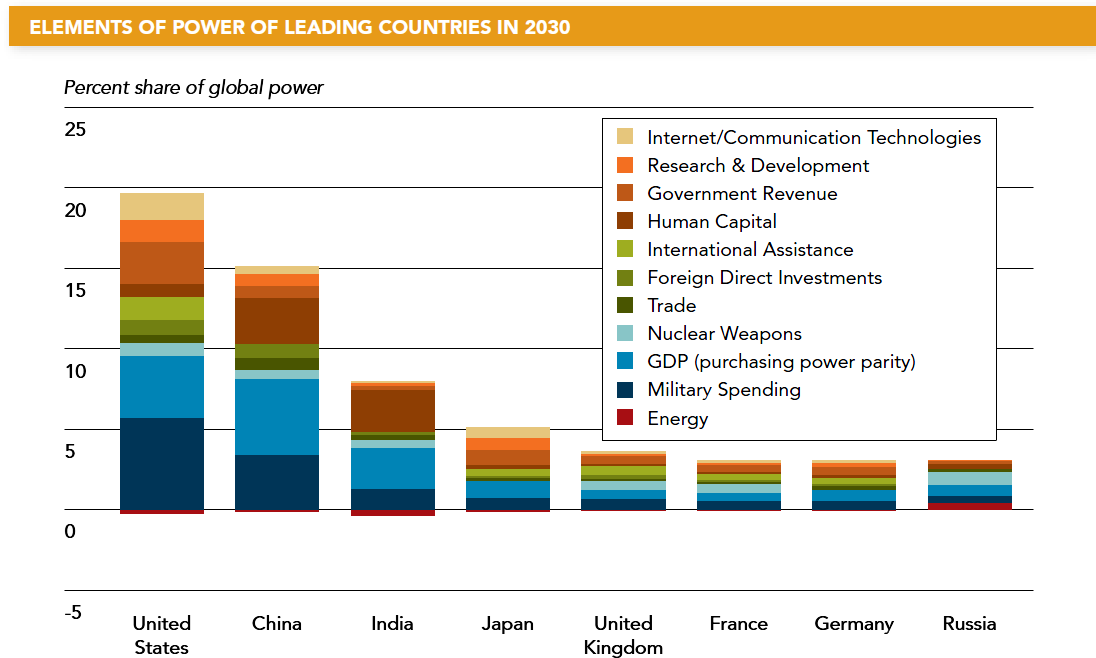
Source: International Futures Model
Human Augmentation
The report sees human augmentation spanning a wide gamut of
technologies, ranging from implants and prosthetics to powered
exoskeletons, for enhancing innate human abilities, or replacing missing
or defective functions such as damaged limbs. Prosthetic limbs have now
reached the stage where they offer equivalent or slightly improved
functionality to human limbs. Brain-machine interfaces in the form of
brain-implants are demonstrating that directly bridging the gap between
brain and machine is possible. Military organizations are experimenting
with a wide range of augmentation technologies, including exoskeletons
that allow personnel to carry increased loads and psychostimulants that
allow personnel to operate for longer periods.
Human augmentation could allow civilian and military people to work
more effectively, and in environments that were previously inaccessible.
Elderly people may benefit from powered exoskeletons that assist
wearers with simple walking and lifting activities, improving the health
and quality of life for aging populations. Successful prosthetics
probably will be directly integrated with the user’s body. Brain-machine
interfaces could provide “superhuman” abilities, enhancing strength and
speed, as well as providing functions not previously available.
As replacement limb technology advances, people may choose to enhance
their physical selves as they do with cosmetic surgery today. Future
retinal eye implants could enable night vision, and neuro-enhancements
could provide superior memory recall or speed of thought.
Neuro-pharmaceuticals will allow people to maintain concentration for
longer periods of time or enhance their learning abilities. Augmented
reality systems can provide enhanced experiences of real-world
situations. Combined with advances in robotics, avatars could provide
feedback in the form of sensors providing touch and smell as well as
aural and visual information to the operator.
Owing to the high cost of human augmentation, it probably will be
available in 15-20 years only to those who are able to pay for it. Such a
situation may lead to a two-tiered society of an enhanced and
non-enhanced persons and may require regulation. In addition, the
technology must be sufficiently robust to prevent hacking and
interference of human augmentation. Advances in synergistic and enabling
technologies are necessary for improved practicality of human
augmentation technologies.
For example, improvements in battery life will dramatically improve
the practicality of exoskeleton use. Progress in understanding human
memory and brain functions will be critical to future brain-machine
interfaces, while advances in flexible biocompatible electronics will
enable better integration with the recipient of augmentations and
recreate or enhance sensory experiences. Moral and ethical challenges to
human augmentation are inevitable.
Technology impacts
Four technology arenas will shape global economic, social, and
military developments as well as the world community’s actions
pertaining to the environment by 2030, according to the report.
Information technology is entering the big data era. Process power and
data storage are becoming almost free; networks and the cloud will
provide global access and pervasive services; social media and
cybersecurity will be large new markets.
This growth and diffusion will present significant challenges for
governments and societies, which must find ways to capture the benefits
of new IT technologies while dealing with the new threats that those
technologies present.
Fear of the growth of an Orwellian surveillance state may lead
citizens particularly in the developed world to pressure their
governments to restrict or dismantle big data systems. Emerging
technologies such as second-generation wireless communications
(smartphones) are also likely to accelerate the empowerment of
individuals, introducing new capabilities to the developing world in
particular.
The second wave of wireless communications engenders a reduced need
for developing countries to invest in and build expansive, costly
communications infrastructures. Such technologies will reduce the
urban-rural split that characterized first-wave technologies, especially
in developing countries.
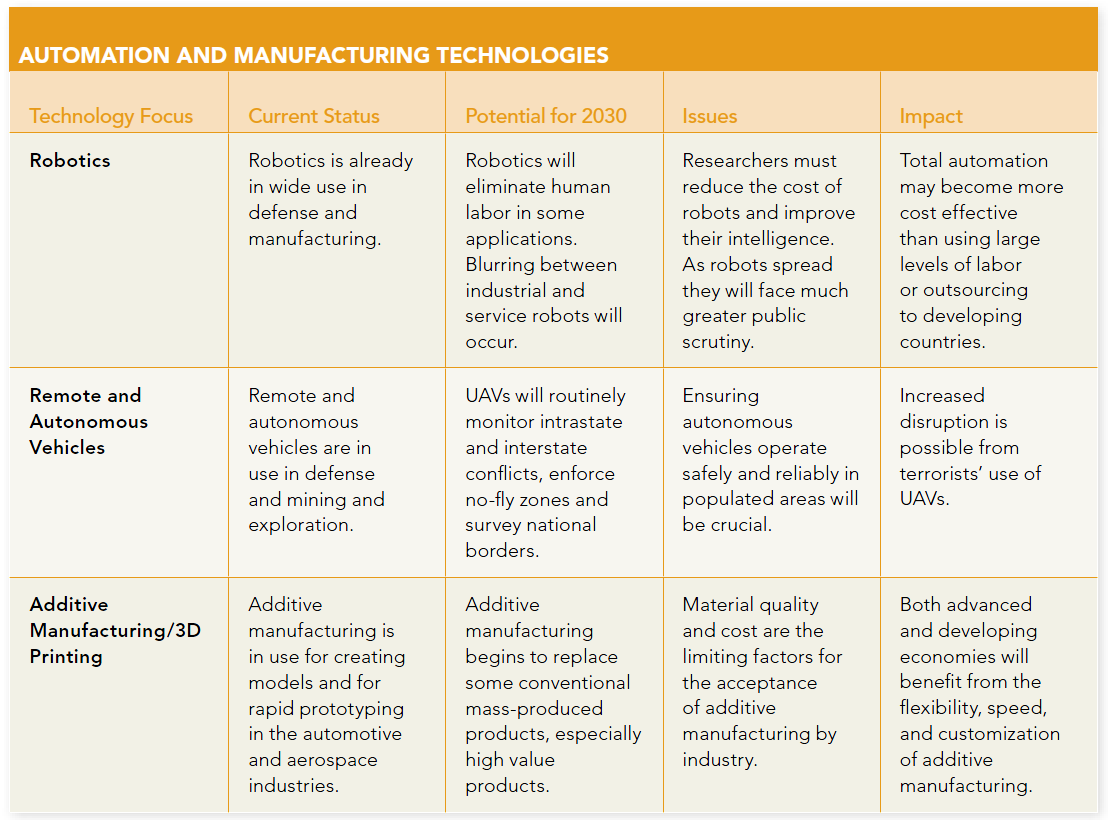
New manufacturing and automation technologies such as additive
manufacturing (3D printing) and robotics have the potential to change
work patterns in both the developing and developed worlds. In developed
countries these technologies will improve productivity, address labor
constraints, and diminish the need for outsourcing, especially if
reducing the length of supply chains brings clear benefits.
Nevertheless, such technologies could still have a similar effect as
outsourcing: they could make more low- and semi-skilled manufacturing
workers in developed economies redundant, exacerbating domestic
inequalities. For developing economies, particularly Asian ones, the new
technologies will stimulate new manufacturing capabilities and further
increase the competitiveness of Asian manufacturers and suppliers.
New health technologies will continue to extend the average age of
populations around the world, by ameliorating debilitating physical and
mental conditions and improving overall well-being. The greatest gains
in healthy longevity are likely to occur in those countries with
developing economies as the size of their middle class populations
swells. The health-care systems in these countries may be poor today,
but by 2030 they will make substantial progress in the longevity
potential of their populations; by 2030 many leading centers of
innovation in disease management will be in the developing world.
Game changers
The report authors also believe that six key game-changers will
largely determine what kind of transformed world we will inhabit in
2030: a crisis-prone global economy, a governance gap, potential for
increased conflict, wider scope of regional instability, impact of new
technologies, and the role of the U.S.
The complete set of Global Trends 2030 documents is available on the National Intelligence Council’s website.


No comments:
Post a Comment