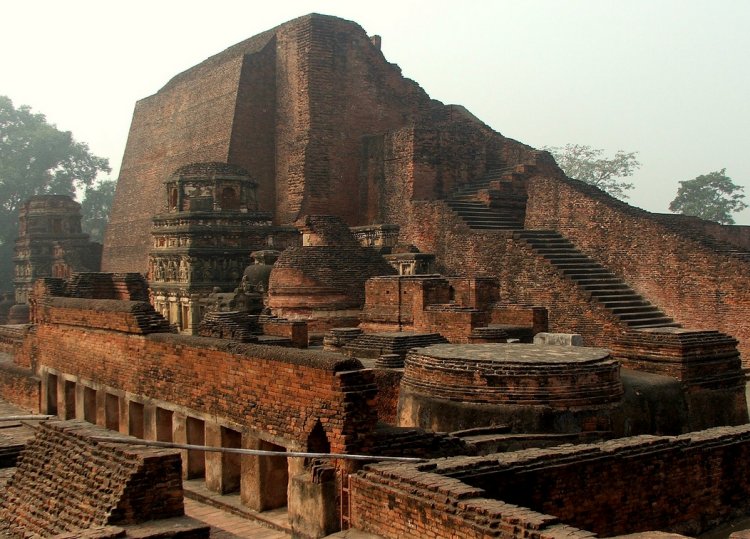
Nalanda was one of the most praised, intellectual circles of the ancient world.
It was an active center of education located about 88 km south-east of Patna in Bihar, northeastern India and not far from what is today the southern border of Nepal.


|
26 August, 2015
![]()
MessageToEagle.com -
What is really behind the story of Phoenix, the bird of immortality, the bird
that rises from the ashes?
The Phoenix is
known in various forms and by various names throughout the Middle and Far
East, the Mediterranean, and Europe. It is a symbol of resurrection. The name
Phoenix may have come from the Greek phoinix and may be related to phoinos
(blood-red).
In ancient Egypt
the Phoenix was called the "Lord of Jubilees," and was considered
to be the ba (spirit) of the Sun God Ra. In Mesopotamia the Phoenix
symbolized by the horned and winged solar disk. Alchemists used the Phoenix
to symbolize the color red and the successful end of a process. The medieval
Hermeticists used the Phoenix as a symbol of alchemical transmutation.
Legends tell that
the Phoenix had feathers of red and gold, the color of the rising Sun. It had
a wonderful melodious voice, which became mournful with approaching death.
Other creatures were then so overcome by its beauty and sadness that they
fell dead.
|


Most of us spend a big part of our day sitting down,
and often when we go home we forgo physical exercise for an evening in front
of the TV or computer. All of these extended sitting sessions lead to us
slouching in our chairs. Even if we start by sitting upright, eventually our
muscles become fatigued, and we slouch, letting our bones take the brunt of
the weight instead of our muscles. Over time, our bad sitting posture becomes
our “regular” posture, and slouching can cause a host of problems: pain in the
shoulders, joints, neck, lower back, knees, and even headaches. The following
exercises will train the muscles in charge of supporting your spine, which
will help you maintain the proper sitting position.
|
![]() |
1. Strengthen your back with the “Warrior” pose
The “warrior” pose is an exercise that strengthens
your thighs and stretches your arms significantly – both are areas that are
important in reducing strain on your spine. |


Image credit & copyright - Robert Torres

Heart attacks have been one of the leading causes of death in the US for many years, and very often, symptoms which could have been spotted well-in-advance go unnoticed. You may perhaps be familiar with the classic signs: a heavy sweat, clutching of the left arm, pain in the chest, and so on. But sometimes signs of a heart attack are not so obvious, particularly amongst women, who often don't seem to realize what's happening to them, or appreciate the seriousness of the situation, until it is too late.
|
Whatever the symptoms may be, do not wait until it's too late. Be aware of what changes are taking place in your body and take necessary precautions - being alert will help save a life, whether it be your own, or a friend's.
|
![]() |
Source: Flickr.com, nokhoog_buchachon
|
What is happening to the body in the process of a heart attack
|
During a heart attack, the supply of blood to the heart is suddenly blocked, usually by a blood clot, which happens due to the build-up of plaque in the coronary arteries. Consequently, this build-up causes a severe loss of blood supply to your heart, which then causes a heart attack.
|
There are two main types:
Sudden: A person may or may not have had any symptoms in the past. All of a sudden, plaque ruptures, which triggers a chain of events and a sudden heart attack.
Gradual: This results from a gradual progression of coronary disease. In these patients, an artery narrows over time. Once it has narrowed down to more than 70 percent, a number of warning symptoms will start to show, possibly even months ahead.
|
| |||||
| |||||
|